

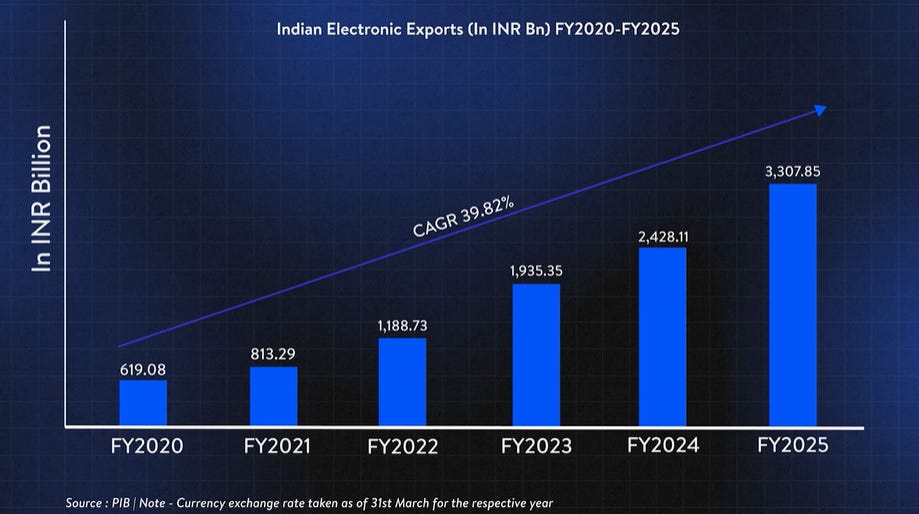
India’s defence trade profile has changed meaningfully over the past decade. Our defence exports rose from ₹1,521 Cr in FY2016-17 to ₹23,622 Cr in FY2024-25, a more than 15x increase in eight years. This is not just a headline number. The mix has evolved from small components and spares to full systems and high-value platforms. Exported items now include the BrahMos cruise missile, Pinaka multi-barrel rocket launchers, advanced surveillance systems, artillery systems, radars, and electro-optical payloads. India has also diversified its export destinations across Southeast Asia, Africa, and parts of Latin America. The Philippines, for instance, has procured the BrahMos coastal defence system, signalling confidence in Indian-origin strategic systems.
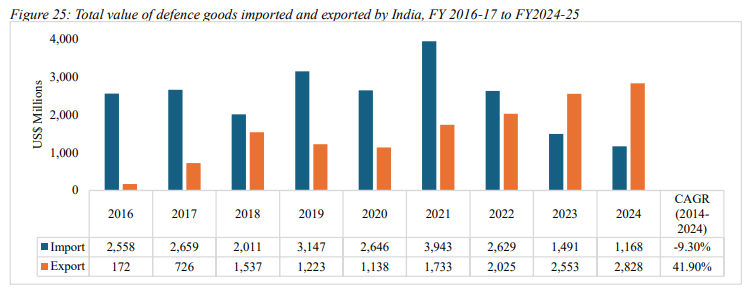
On the import side, while India still remains one of the largest defence importers globally, but the pattern is shifting. Earlier cycles were dominated by large-ticket platform imports such as fighter aircraft, submarines, and artillery systems. Today, imports are increasingly concentrated in critical technologies where domestic capability is still limited. These include aero-engines, high-end radar systems, advanced propulsion, niche electronic warfare systems, and certain semiconductor-intensive subsystems. Government is pushing toward indigenisation through positive indigenisation lists and procurement prioritisation, aimed at gradually reducing reliance on imported platforms. In effect, India is moving from being a pure buyer of finished platforms to a country that increasingly manufactures, integrates, and exports.
The reasons for this shift are structural:
Policy: The Defence Acquisition Procedure 2020, the Aatmanirbhar Bharat push, and higher capital outlays have directed procurement toward domestic industry. The Union Budget FY2026–27 allocated around ₹2.19 lakh crore toward defence capital outlay, a 20% increase YoY, creating sustained demand for indigenous systems.
Geopolitics: Border tensions with China and Pakistan have accelerated domestic production of surveillance systems, UAVs, artillery, and network-centric capabilities.
Industrial Ecosystem Development: Over 15,000 MSMEs now participate in defence supply chains, supporting DRDO & DPSUs with components ranging from avionics to electro-optical systems. Defence corridors in Uttar Pradesh and Tamil Nadu are aimed at building manufacturing clusters in the country.
What one should understand is that the real story is not just rising exports but changing composition and capability depth. India’s defence burden is rising alongside global spending trends, and modernization is becoming a larger share of budgets globally. For India, export growth is strong in percentage terms but still small relative to global defence trade. Amidst escalating trade and geopolitical disputes and a trend of national security prioritisation, global military expenditure is projected to register a 5% CAGR between 2024-2030, reaching $3.6 tn by 2030. These structural shifts are expected to provide strong tailwinds for defence contractors and their associated supply chains.
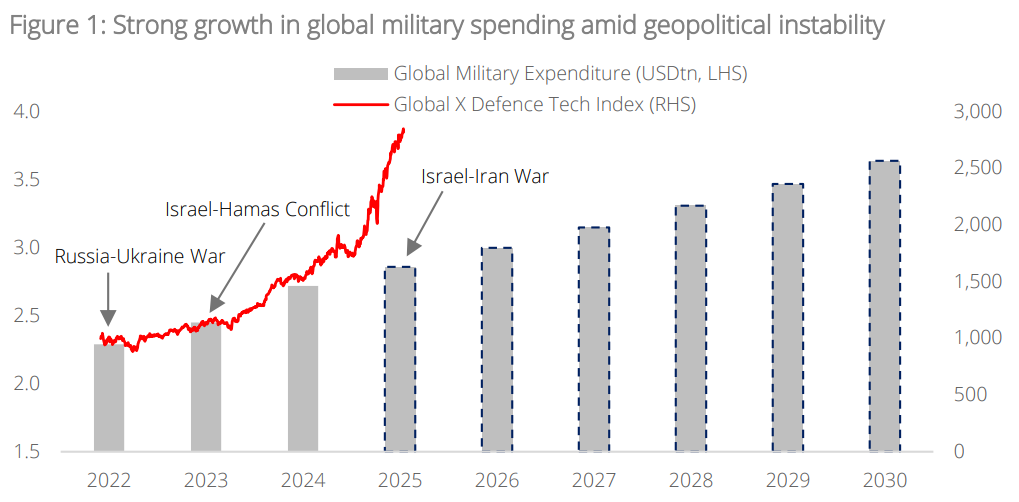
Adding to it, by CY2030, ‘modernization’ spend (read electronics) is expected to account for 30-45% of defence budgets in advanced economies (vs 15-25% in emerging economies). The biggest thrust will be towards electronics like unmanned and counter-UAS systems, with rising investments in loitering munitions, thermal imaging, radar discrimination, and directed energy systems. With defence manufacturing is also becoming digital-first, use of advance tech & electronics across biggest markets like U.S. and Europe is bound to rise.
For India, the next phase will depend on how much value addition India can achieve in high-technology domains such as advanced seekers, propulsion, sensors, and electronic warfare.
While the market size globally for defense electronics market is rising from $64.8 Bn in 2020 to $226.8 Bn by 2030, growth rate is fastest in India rising from $2.2 Bn to $17.83 Bn at CAGR of 23.3% in same time frame. (source)
So if the future of India’s defence story is about electronics, then the real question becomes execution. Who is actually building high-reliability, mission-critical electronics inside India?
To explore that, we recently visited our portfolio company Vinyas Innovative Technologies in Mysuru. In a conversation between Angad Kapur, Principal at Singularity, and Sumukh N., Director at Vinyas, what emerged was not just a factory tour but a window into how India’s defence electronics capability is maturing.
From EMS to Engineering-Led Manufacturing
Vinyas began as a traditional Electronics Manufacturing Services(EMS) player. Under the leadership transition from founder to second generation, the company has deliberately shifted its positioning.
Sumukh, who returned from the US in 2018, articulated the pivot clearly. The goal was not just to assemble boards, but to add engineering value to manufacturing. Over the last seven years, the focus has been on high-mix, high-reliability, high-complexity PCB assembly and system integration.
This distinction matters.
In defence and aerospace, value does not sit in volume. It sits in:
Complexity
Certification
Reliability
Vinyas operates in low-volume, high-complexity environments where qualification cycles can stretch 10 to 12 months. Once qualified, however, customers tend to be extremely sticky. That structural stickiness is a defining feature of defence electronics supply chains.

Mission-Critical Subsystems, Not Commodity Boards
The company manufactures mission-critical electronic subsystems used across defence platforms, ranging from naval gun systems to other specialised applications. These include joysticks, power supplies and control modules that ultimately sit in the hands of end users.
Unlike commercial electronics, these products must undergo extensive qualification and testing before deployment. The certification and validation process is far more detailed than in consumer or industrial segments. Convincing a customer to even begin qualification represents a significant milestone.
Once approved, however, the relationship becomes long-term. In defence, switching suppliers is not a trivial exercise. This creates durability in revenue streams, albeit with longer gestation cycles.
Vinyas describes itself as a high-mix, high-complexity manufacturer. It does not chase large-volume consumer electronics. Instead, it focuses on segments where reliability standards are stringent and failure tolerance is near zero.
Certification as a Strategic Moat
In aerospace and defence electronics, certification is not a marketing badge. It is a barrier to entry.
Vinyas is certified under AS9100-D, the global quality standard for aviation, space and defence. More importantly, in May 2025, it secured NADCAP accreditation. Globally, only a small cohort of companies hold this certification in relevant categories.
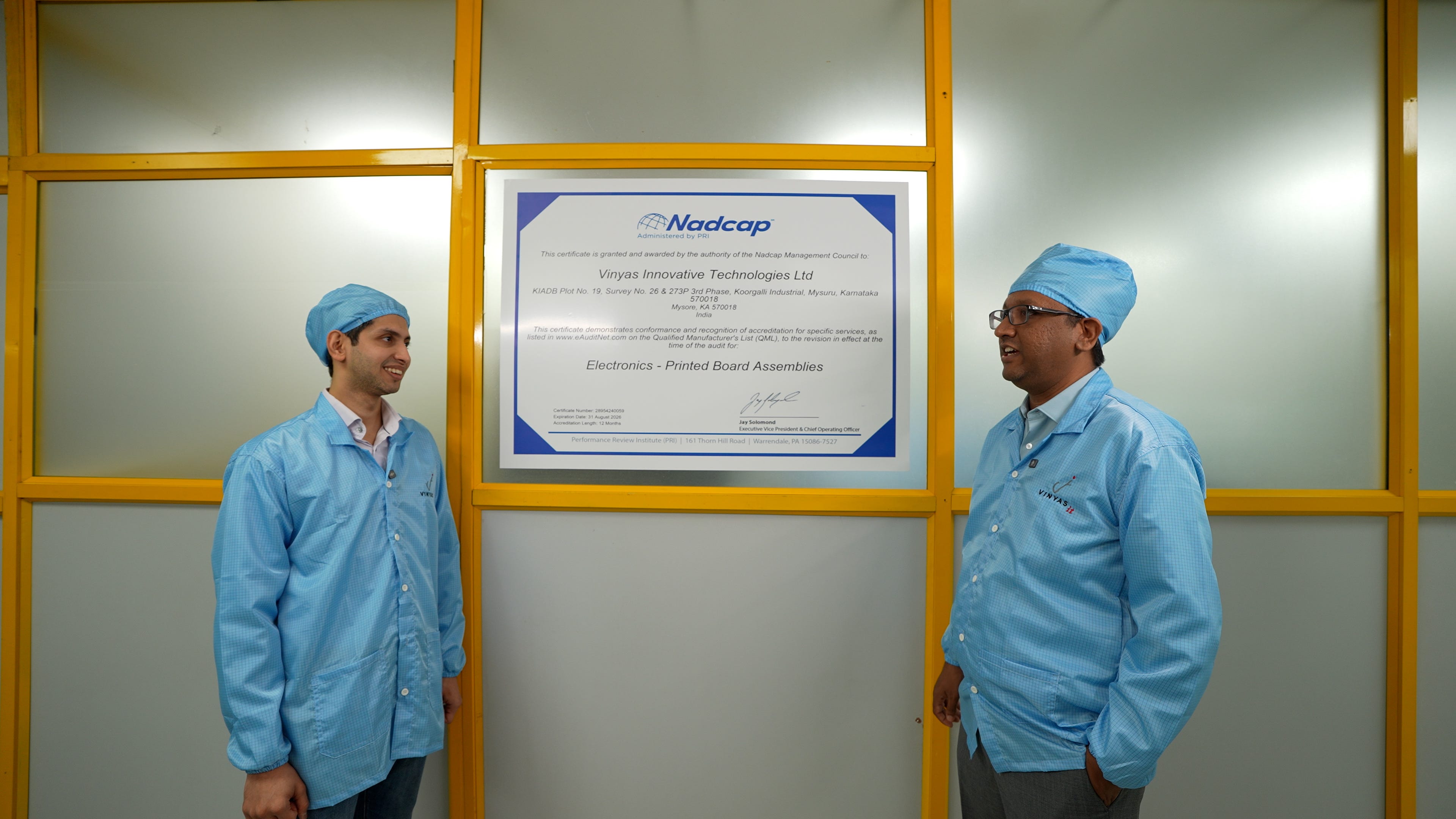
The process took nearly four years, with the last two described as particularly gruelling. But the outcome places Vinyas in a narrow global niche.
For international OEMs evaluating Indian suppliers, such certifications alter perception. Historically, one of the biggest challenges for Indian electronics manufacturing was credibility. The belief that India could not deliver high-precision, high-reliability systems at global standards was deeply entrenched.
That perception is shifting.
Sumukh pointed out that when he moved back in 2018, the common refrain was that India could not manufacture at global quality levels. Over the past five years, aided by localization policies and the Aatmanirbhar push, global OEMs have begun to re-evaluate India as a serious manufacturing hub. Recognition of the Indian supply chain is no longer aspirational, it is becoming operational.
Digitisation and Process Discipline
One of the less visible but more important aspects of modern defence manufacturing is digital process control.
Vinyas estimates that its facility is now 85-90% digitised. This includes traceability, process monitoring and workflow integration. In high-reliability environments, documentation and digital control are as important as hardware capability.
The company runs structured 90-minute production cycles, followed by a short pause that includes a 90-second meditation ritual. While this may seem cultural, it reflects an emphasis on rhythm, discipline and error minimisation. Even during the NADCAP audit cycle, this process discipline was reviewed. In a sector where audit trails and process validation define credibility, such systems become competitive advantages.
Digitisation also reduces cycle times and improves engagement with larger OEMs. For companies looking to integrate Indian suppliers into global programmes, process transparency is critical.
Vertical Expansion and Moving Up the Stack
While defence and aerospace remain core, Vinyas is now looking at vertical expansion into adjacent segments such as commercial aerospace, medical devices and industrial electronics.
The strategic intent is clear. Move up the value chain from PCB assembly toward subsystem and system-level integration. Higher integration typically translates to higher value capture and stronger customer entrenchment.
This mirrors the broader national trajectory you outlined earlier. India’s next phase in defence electronics will not be defined merely by assembling imported components. It will be defined by deeper subsystem ownership, integration capability and eventually indigenous design in critical areas.
Vinyas appears to be positioning itself for that transition.
Long-Term Orientation in a Structural Shift
Perhaps the most important theme from the conversation was mindset.
The transition from a founder-led enterprise to a more institutional structure is ongoing. The emphasis is on long-term stability over short-term visibility. In defence electronics, order cycles can be long and qualification timelines demanding. Patience becomes strategic.
India’s defence modernization cycle, global electronics intensity in military systems and policy-led localization are creating structural tailwinds. But execution will determine who captures value.
The story of Vinyas is not about scale in the conventional sense. It is about credibility, certification, process depth and moving steadily up the integration curve.
If India’s defence exports have moved from components to systems, the next leap will depend on companies that can combine manufacturing precision with engineering depth. That is where the real value addition will lie.
Check out our latest posts below:
Mastering the Modern Influencer Playbook

The Investor Operator Playbook: From Face to Founder, How mCaffeine Combined Authenticity with Execution

I agree the 71 percent groeth is there but 1 crore in net profit and -37 crore free cashflow on top on 29 percent promoter holding can u pls clarify the equity structure of the company i think im wrong