

India's fossil fuel import bill is on track to cross $200 Bn in FY2027 and reducing that dependence is central to India’s strategic autonomy for energy security.
Over the past eight years, Singularity AMC has deployed more than $200 Mn across solar, transmission and distribution, biofuels, and commercial EVs, backing founders who moved early on India's energy transition before the mandates caught up with them. TruAlt Bioenergy is one example on the ethanol side, scaling from 390 KLPD to 2,000 KLPD in roughly four years to become India's largest ethanol producer by installed capacity. Greenjoules is the fund's next bet on the same thesis, this time aimed at the diesel half of the problem that ethanol cannot solve (read more about the fund raise here). Biodiesel is the drop-in answer, chemically close enough to fossil diesel that it needs no engine modification and carries none of ethanol’s blend-wall constraints.
Yet nowhere in the world has biodiesel scaled cleanly yet. First-generation biodiesel, built on palm, soy, and rapeseed, has deforested an area the size of the Netherlands since the 2000s chasing food-based feedstock. Second-generation biodiesel, built on agricultural waste instead of food crops, has a worse track record still, a graveyard of well-funded projects like KiOR and Range Fuels that worked at pilot scale and collapsed when they tried to commercialise. India’s agri-waste surplus, over 500 million metric tonnes a year, at significantly lower costs than US and EU biomass, is the first structural reason this pattern might not repeat here. Whether the economics finally close is the question the rest of this piece tries to answer.
Greenjoules was founded in 2018 by Viraraghavan Sankaran, an ex-Cargill executive, out of a bio refinery in Chakan, Pune. They build a process that converts agri-waste and agro-industrial byproducts into fuel that is chemically identical to fossil diesel, without the feedstock constraints of first-generation biodiesel and without the upgrading costs that broke second-generation projects globally.
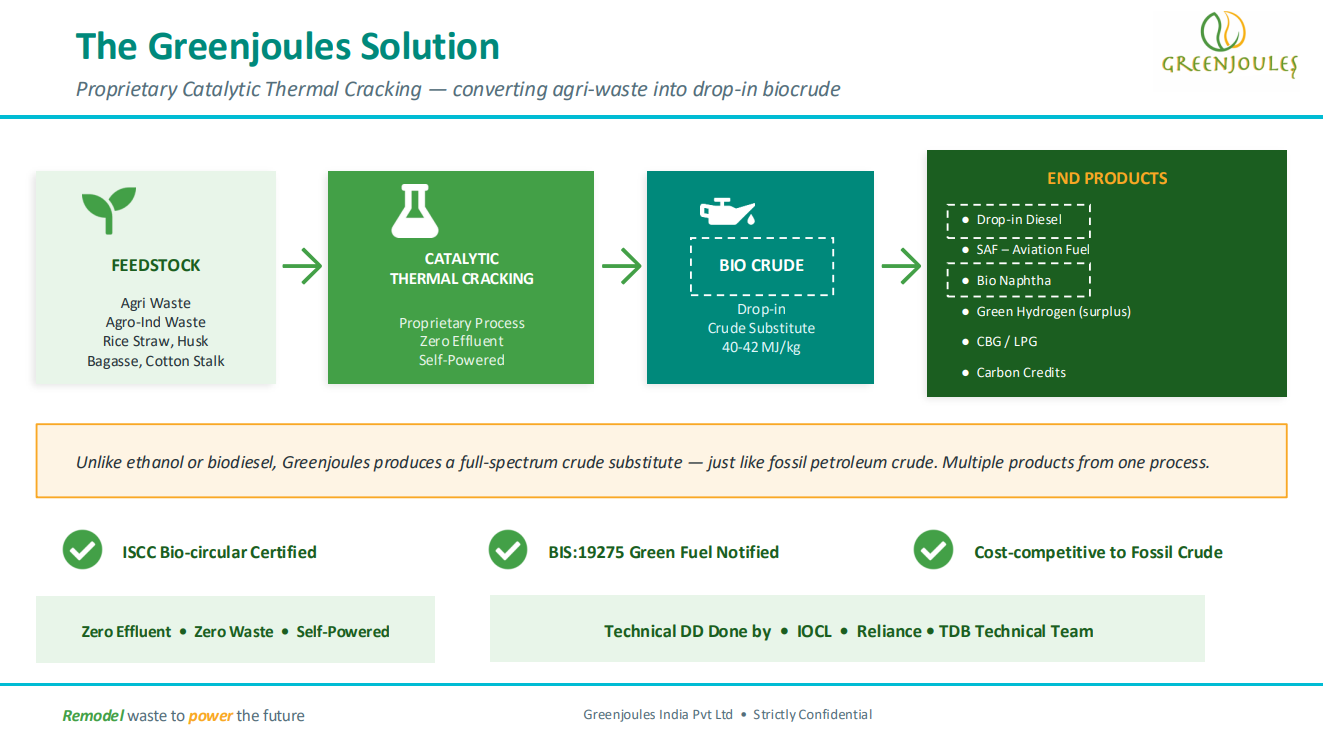
Key core technology is their proprietary catalytic thermal cracking process that converts non-edible biomass into bio-crude, creating a flexible hydrocarbon platform capable of producing renewable diesel, SAF, bio-naphtha, and other refined products, with more flexible raw material requirements than biogas or ethanol technologies.
It is, on paper, exactly the kind of clean story India has heard before on the ethanol side, but took time to play out. Ask anyone who tracked the Indian sugar industry through the 2010s and they will tell you the same thing: ethanol blending was always the idea that should have worked but never quite did. The value proposition of ethanol blending was obvious, India had surplus sugarcane to produce ethanol, it imported half its crude, and blending the two was a natural hedge. Yet for most of the decade, actual blending numbers sat below 5%, hobbled by pricing standoffs and supply gaps, and the programme accumulated more policy papers than it did litres.
Hence, when the government set the E20 target in 2018, most people in the energy sector treated it as aspirational at best. Ethanol blending had been stuck below 5% for years, held back by pricing disputes between sugar mills and oil companies, by interstate movement restrictions, and by a feedstock base too narrow to scale. Many things changed:
Administered prices that gave distilleries revenue certainty
Long-term offtake agreements with refineries that removed demand risk
6% interest subvention on distillery loans
Gradual opening up of feedstocks from molasses to sugarcane juice to grain to FCI surplus rice to maize.
The result was a tripling of distillery capacity in seven years and a blending curve that bent sharply upward right around 2020 and never looked back.
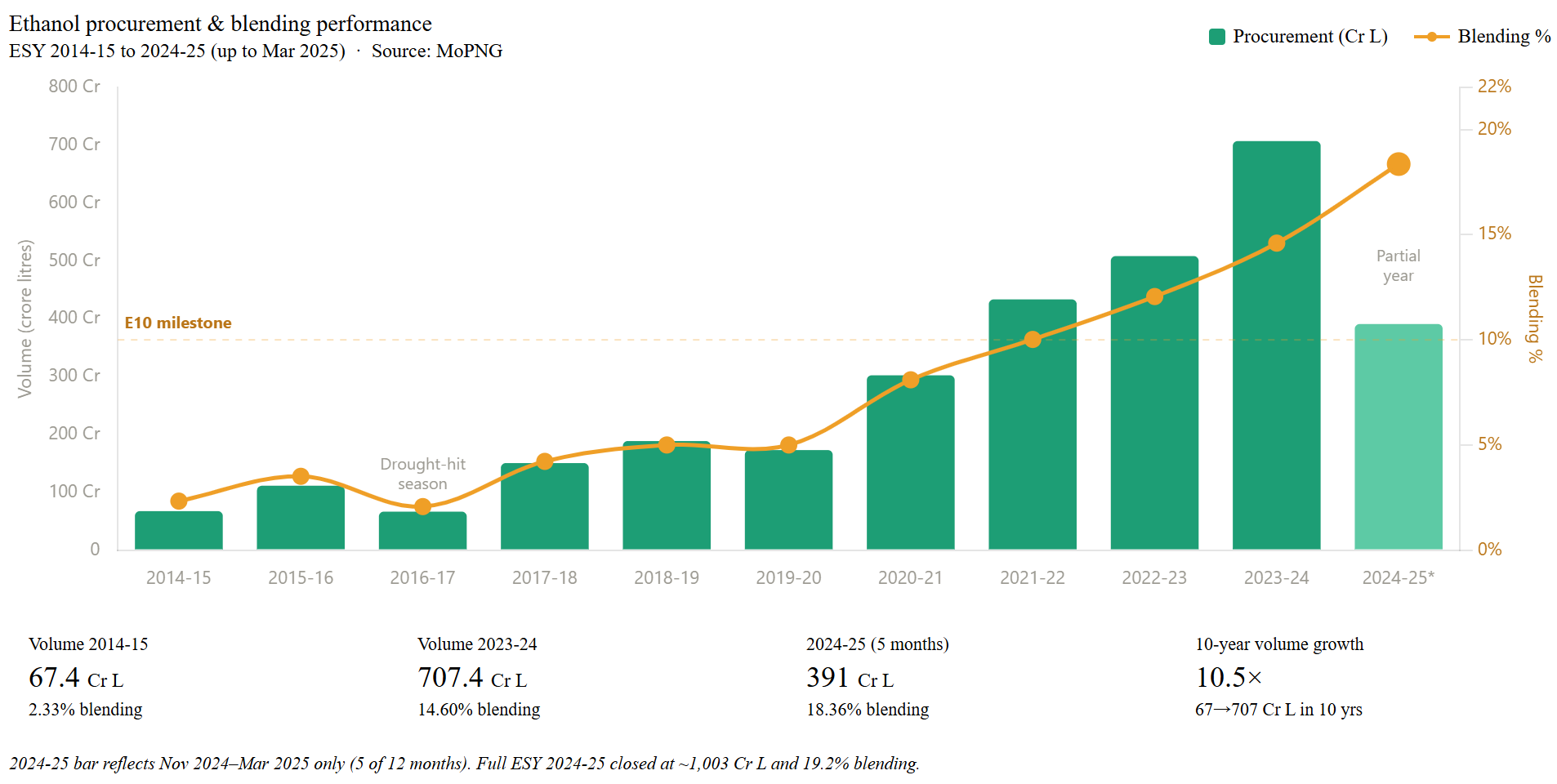
For the manufacturers, refiners, and farmers who positioned themselves on the right side of that curve, the rewards were great. Over Rs 1.96 lakh crore paid to distilleries, over Rs 1.18 lakh crore reaching farmers directly in last decade. India's saved an estimated Rs 1.84 lakh crore in foreign exchange as an outcome that directly impacts our energy security, economy and currency. The blending rate crossed 10% in 2022, cleared 14% by 2024, and reached 20% by mid-2025, five years ahead of the original 2030 target. Anyone waiting for the volume before taking the mandate seriously missed the window in case of Ethnol. That window was the gap between the mandate & the volume.
Ethanol blending solved the petrol problem, but India's much larger diesel market remains largely untapped, with annual diesel consumption of around 12,400 crore litres compared to 6,200 crore litres of petrol. Ethanol cannot be blended into diesel at meaningful scale. The feedstock, the chemistry, and the distribution infrastructure are entirely different. So while the E20 story is a genuine policy success, it leaves the larger half of India's liquid fuel consumption almost untouched. Ethanol's role is also bounded by blending limits, meaning it cannot directly substitute fossil fuels the way drop-in fuels can. Pushing past E20 towards E85 or higher is not simply a policy dial, it requires flex-fuel vehicles capable of running on higher ethanol ratios, and India's existing fleet is not built for that. It also reopens a food versus fuel conundrum, since higher blending ratios pull harder on sugarcane and grain feedstocks that also serve food and fodder markets. The government's recent push on E-85 signals ambition beyond E20, but between the vehicle transition and the feedstock tension, the diesel challenge remains structurally unresolved.
Understanding Biofuels and Biodiesel
Biofuels are liquid fuels derived from biological material rather than fossil sources. The most prevalent example is ethanol, the fuel underpinning India’s ethanol blending programme. Ethanol is produced through fermentation, where sugarcane juice, molasses, or starch-rich grains are broken down by microorganisms into alcohol, which is then distilled and blended with petrol. The process is well understood, the feedstocks are agricultural commodities India already produces at scale, and the infrastructure to collect, process, and distribute ethanol has been built up over decades.
Biofuels are broadly classified into first-generation (1G) and second-generation (2G) categories based on the feedstock used. First-generation (1G) biofuels are produced from edible crops such as sugarcane, corn, wheat, and vegetable oils. Most of India’s current ethanol production falls into this category, relying on sugarcane-based feedstocks. In contrast, second-generation (2G) biofuels are produced from non-food biomass, including agricultural residues such as rice straw and wheat straw, forestry waste, and other lignocellulosic feedstocks. Ethanol itself can be produced through either pathway, with 2G ethanol offering the advantage of utilizing waste biomass that would otherwise be discarded or burned, albeit through a more technologically complex and capital-intensive process.
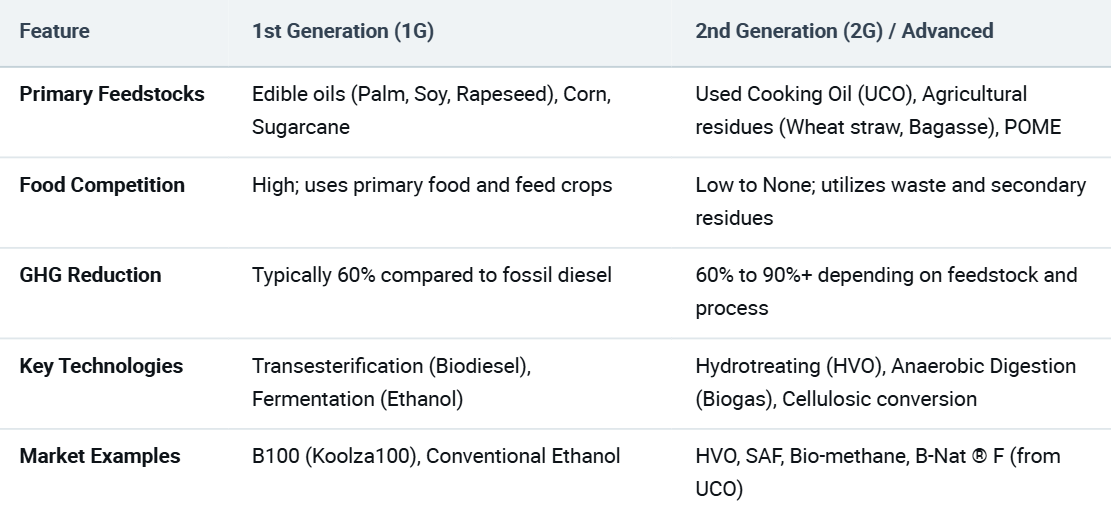
Biodiesel is a different chemistry entirely. Rather than fermentation, it is produced through a process called transesterification, where fats or oils react with an alcohol to produce fatty acid methyl esters, the compound that can substitute for petroleum diesel.
First-generation biodiesel uses edible oils and oilseeds as its feedstock, which creates an immediate tension with food supply and puts a hard ceiling on how much can realistically be produced.
Second-generation biodiesel sidesteps that constraint by starting with non-food material: agricultural residues, agro-industrial waste, used cooking oil.
The fuel that comes out the other end is chemically close enough to petroleum diesel that it can be dropped into existing engines and supply chains without modification. That compatibility is what makes it a credible answer to the diesel problem ethanol cannot solve.
If Biodiesel Is the Diesel Equivalent, Why Hasn't It Scaled?
Biodiesel’s global story is largely a first-generation story, and that is precisely the problem. The countries that scaled biodiesel earliest, the European Union, the United States, Indonesia, Brazil, did so by processing edible oils: palm, soy, rapeseed, canola. Since the 2000s, an area equivalent to the Netherlands has been deforested globally to supply biodiesel feedstock demand, driven almost entirely by first-generation sources.
When it comes to second-generation biofuels, its been a graveyard of well-funded bets globally that never closed commercially. Range Fuels, backed by over $160 Mn in investor and government capital, collapsed in 2011 after failing to fine-tune the process that fed wood chips into its gasifier. KiOR, which claimed it could produce drop-in fuels from pine wood, filed for bankruptcy in 2014 having shut its Mississippi refinery, despite receiving tens of millions in government grants. Abengoa mothballed its cellulosic ethanol refinery in Kansas in 2015, after receiving a $97 Mn Department of Energy grant. DuPont opened a $200 Mn cellulosic ethanol plant in Iowa in 2015, promised it was the first of many, and had it on the auction block by 2017. The pattern across all of them was similar: the technology worked at pilot scale, the economics looked plausible on paper, but the jump to commercial scale exposed feedstock variability, yield gaps, and capital structures that could not survive without subsidy.
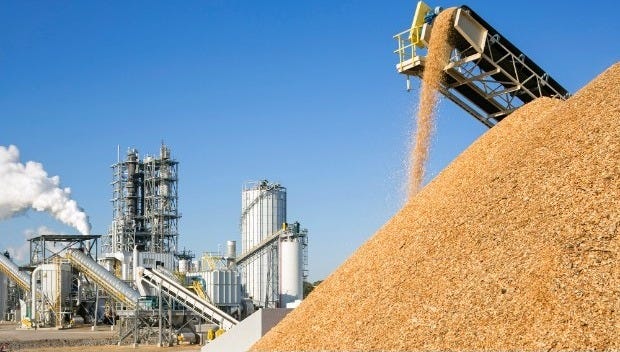
The technology always existed and worked at pilot scale, the economics looked plausible on paper, but the jump to commercial scale exposed feedstock variability, yield gaps, and capital structures that could not survive without subsidy.
Biomass feedstock in the EU and US cost $60 to $100 per tonne, and below $60 per barrel oil, the economics of converting it into fuel simply collapsed. The bio-oil that thermochemical processes produce carries 40 to 45% oxygen content, making it corrosive and unstable, requiring two to three stages of expensive hydrotreatment before it is usable as fuel. Plants built around a single feedstock, wood chips in KiOR's case, ran at 40 to 50% utilisation because supply was seasonal and thin, leaving fixed costs to eat through returns. KiOR itself jumped from pilot directly to a $500 million commercial plant, promised yields of 67 gallons per bone-dry tonne, delivered 30, and burned through $629 Mn of its funding before the unit economics were ever proven.
How India Fundamentally Solves This?
Firstly, Agri-waste in India costs Rs 3 to 5 per kg, translating to roughly $35 to 60 per tonne, already 15 to 25% below EU and US biomass costs. More importantly, India generates over 500 million metric tonnes of agri-waste annually, with 228 million metric tonnes in surplus. Stubble burning, the practice that turns North India's skies grey every winter, could become part of the solution. What if we could convert it into a diesel-equivalent fuel?

The second question is whether the expensive upgrading stage that broke global 2G projects is an inevitable feature of the chemistry, or an engineering problem that can be solved. The two to three step hydrotreatment required to stabilise high-oxygen pyrolysis oil was what made the cost stack unworkable in the US and Europe. If ‘catalytic thermal cracking’ can be tuned to produce drop-in diesel meeting fuel standards directly, with no secondary hydrotreatment and no hydrogen input, that costliest stage disappears entirely.
The third question is utilisation. KiOR ran on wood chips alone and sat idle half the year. If a plant can draw from 40-plus feedstock types with moisture content as the only real constraint, utilisation above 70% becomes structurally achievable.
The Company That May Have Solved It
Beyond the technology, what stands out about Greenjoules is the early traction it has built. Customers that have already tested or approved its fuel include Amazon, Hindustan Unilever, L&T, L’Oréal India and others. Instead of waiting for policy support or offtake certainty, Greenjoules went out and built demand with large corporates that have strong sustainability mandates. These customers became early validators, which in turn helped Greenjoules open conversations with oil marketing companies like IOCL. If volumes scale as expected, this could eventually give them the ability to sell at refinery scale.
Greenjoules draws from two input categories:
Agricultural waste including paddy straw, cotton stem, soy stem, rice straw, and wheat straw
Agro-industrial waste from corn milling, starch processing, flour production, chilli processing, and turmeric processing
The optimal mix is roughly 50% agricultural residue and 50% agro-industrial waste. Agro-industrial waste can be procured in bulk from single large suppliers, smoothing the aggregation problem that makes pure farm-waste models operationally difficult. The only constraint on feedstock acceptance is moisture content below 10%. With 100 kg of raw material converting to 55 litres of biocrude, and sourcing spread across crop rotation cycles, the plant can realistically target above 80% utilisation, against the 40 to 50% that single-feedstock models typically achieve.
The company uses the catalytic thermal cracking for producing the second-generation biodiesel that starts with feedstock preparation, where agricultural residues and agro-industrial waste are cleaned of moisture, ash, and polymers before anything else happens. The prepared material then enters a catalytic thermal cracking unit, which breaks it down at high temperatures to produce bio crude, roughly 55-60% of the input by weight. The remaining input yields LPG-like gas at 15-20% and biochar at a similar share, the latter going back into soil as an amendment (output & their proportion varies process to process).
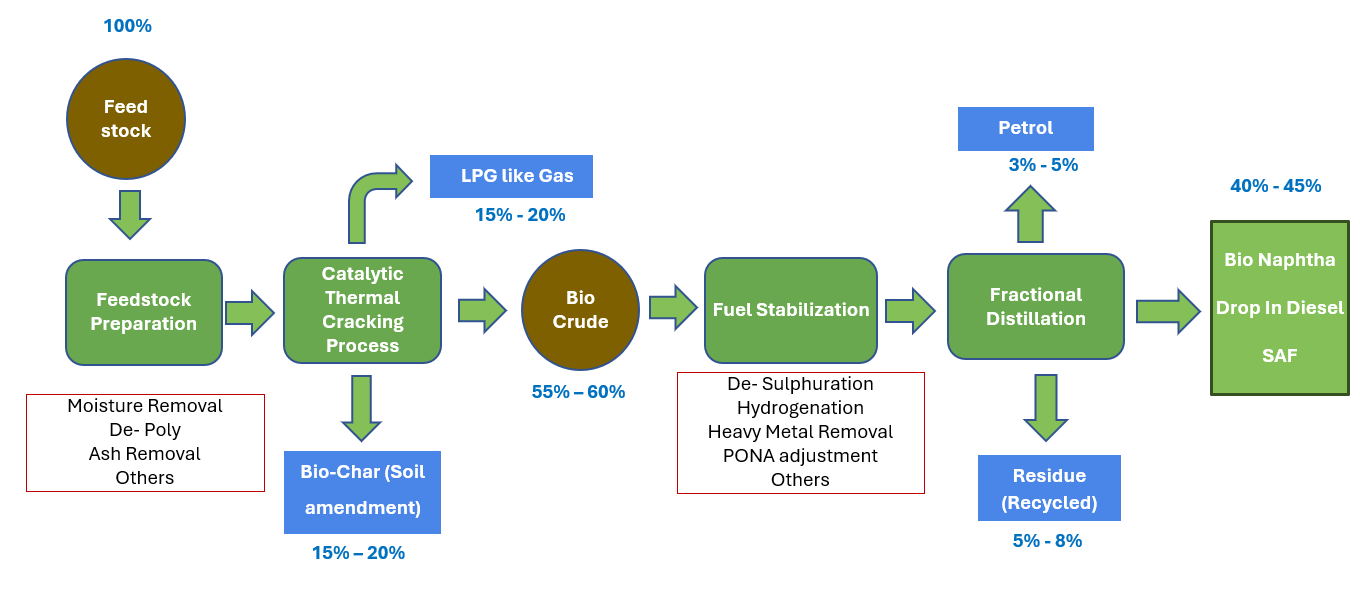
The bio crude is not yet usable as fuel. It goes through a stabilisation stage covering de-sulphurisation, hydrogenation, and heavy metal removal before fractional distillation separates the final outputs: drop-in diesel, bio naphtha, and SAF. What comes out is chemically identical to fossil fuel equivalents, needs no engine modification, and carries none of the blend wall constraints that limit conventional FAME biodiesel.
Where This Beats Ethanol and CBG on the Fundamentals
Unlike ethanol, Greenjoules produces fuel that is chemically identical to fossil diesel, eliminating blend limits and allowing it to directly replace conventional diesel. Its feedstock also avoids the food-versus-fuel trade-off. Instead of relying on crops like maize or sugarcane, Greenjoules uses agricultural and agro-industrial waste, removing the supply constraints that eventually limit ethanol blending.
The economics are equally compelling. While maize-based ethanol typically operates at gross margins of around 28%, constrained by the cost of food-grade feedstock, Greenjoules starts with low-cost waste, creating a path to profitability without depending on subsidies.
Finally, its flexible feedstock model supports far higher plant utilisation. Traditional ethanol and CBG plants, dependent on one or two seasonal feedstocks, often operate at just 40–50% utilisation. Greenjoules can process 42 different feedstock types across crop cycles, enabling year-round sourcing, utilisation above 80%, lower working capital requirements, and the flexibility to shift between feedstocks as economics change.
Why Greenjoules Fits the Singularity Lens
At Singularity AMC, we have been backing founders with ambition, early conviction, and strong execution, especially in sectors shaping India’s energy transition, investing across solar, transmission and distribution, biofuels, commercial EVs and more. India’s fossil fuel import bill represents a significant drain on the country’s foreign exchange reserves and underscores the urgency of reducing dependence on imported energy. While India has successfully achieved 20% ethanol blending in petrol, biodiesel blending remains at a nascent stage. However, under the National Policy on Biofuels, the government has set a target of 5% biodiesel blending in diesel by 2030, creating a ready source of demand for the sector.
Greenjoules has secured Rs 100 Cr from Technology Development Board, Department of Science & Technology (DST), Government of India under the Rs 1 lakh crore RDIF program, a government-backed facility designed specifically for commercialising advanced TRL technologies. Having reached TRL 7/8, the technology has been substantially de-risked and is now positioned for scaled deployment, presenting a compelling entry opportunity. From their Biocrude, Greenjoules can extract various fractions of hydrocarbons, including high value Naphtha, Sustainable Aviation Fuel (SAF), and Diesel + Kerosene
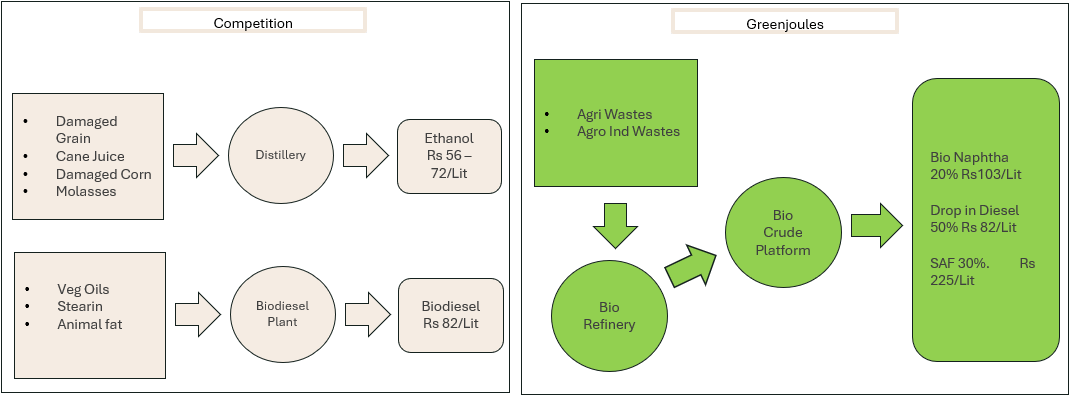
With the flexibility to draw from 42 identified feedstocks, operate across multiple agricultural and agro-industrial waste streams throughout the year, and convert every 100 kg of input into roughly 55 litres of biocrude, the model allows for utilisation above 80% as a natural outcome of the underlying feedstock architecture.
What Lies Ahead
The catalytic thermal cracking process also generates green hydrogen, LPG, CBG, and other non-fuel chemicals as byproducts, with green hydrogen positioned as potentially the cheapest source of green hydrogen available today. This is closer to a TRL 7 than a TRL 3 opportunity, the chemistry already produces these outputs, what remains is separating and purifying them into sellable, standalone products. Alongside this, the company is pursuing a set of other projects in the TRL 4 to 7 range, representing the pre-commercial pipeline still working through validation.
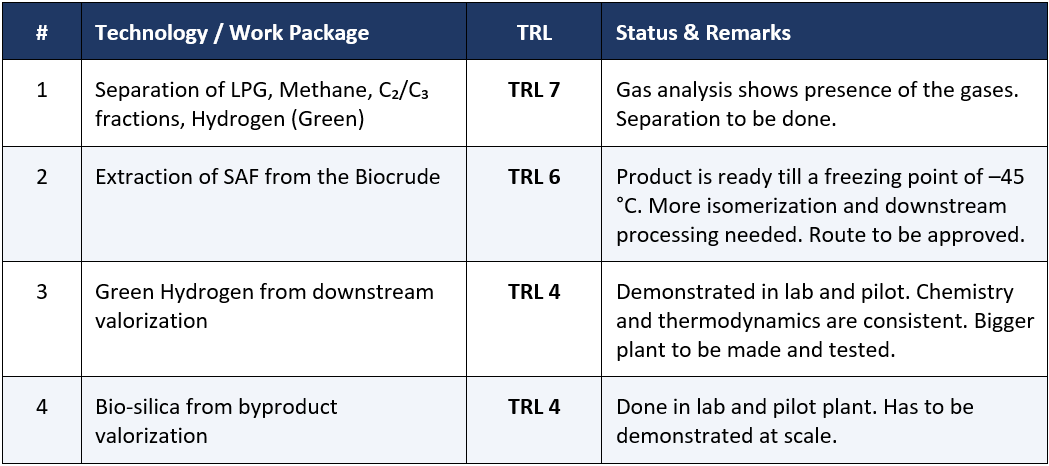
TRL (Technology Readiness Level): A 1-9 scale used to assess a technology’s maturity, from early concept (TRL 1-3) to validated prototype (TRL 4-6) to proven, deployment-ready system (TRL 7-9). Originally developed by NASA, now widely used across energy, defence, and deep-tech investing to benchmark commercialization risk.
To End
There is no “One Silver Bullet“ for India’s oil import bill. Ethanol is solving the petrol problem. Biodiesel is closing in on diesel. Compressed biogas is scaling off municipal and agricultural waste. Coal gasification chips away at chemicals and fertiliser feedstock. Each solves a slice, none solves the whole, and all need to scale together for the dent to show up in the numbers.
Ethanol proved India can move faster than consensus expects when policy, economics, and execution align. If Greenjoules can scale commercially, biodiesel closes the piece of the puzzle ethanol never could, agricultural waste turning from liability into a strategic fuel.
Thanks for reading this blog. Share your feedback in the comments below!
Read recent blogs below:


the 5% target has sat in policy for years without pulling demand. usda projects india's biodiesel blend this year at 0.63% of on-road diesel